What is an HS code?
An HS code (Harmonized System) is a number used to classify traded products. The World Customs Organization (WCO) manages the system. More than 200 countries use it, together covering more than 98% of world trade. More background is in our guide on how HS codes work.
The first six digits are the same everywhere. A cotton T-shirt has the same 6-digit code whether it enters the EU, the US, Japan or Brazil. After that, countries and trade blocs add their own digits for their rates, measures and rules.
In the EU the code is extended to 8 digits (the Combined Nomenclature, CN) and then to 10 digits (the TARIC code). EU measures such as anti-dumping, quotas and surveillance depend on the last one.
How a code is built: set of stainless steel cutlery
6-digit subheadings in the Harmonized System
codes in TARIC a product can be classified in
countries use the Harmonized System
Why the right HS code matters
The HS code decides four things that cost you money or can get you into trouble.
1. The duty you pay
Every TARIC code has its own rate. A stainless steel drinking bottle without vacuum insulation is a household article of stainless steel (7323.93, 3.2% duty). If the bottle is vacuum insulated, it is a vacuum flask (9617.00, 6.7%). Pick the wrong one and you pay too much or too little on every shipment, and customs can recover what you underpaid. How rates are set is in our guide to import duties.
2. Customs checks
In an audit, customs looks at the classification first. If customs finds a wrong code, even by accident, it can claim the difference up to three years back, plus interest. Using a wrong code on purpose is customs fraud.
3. Anti-dumping and other measures
Anti-dumping depends on the HS code and the country of origin. If your product falls under a code with such a measure, it can cost a lot of money, and not knowing it applied is no excuse. More in our guide to anti-dumping.
4. Licences and restrictions
Some codes need an import licence, a phytosanitary certificate, CE marking or other documents. With a wrong code your shipment can be let through when it should not have been, or held when everything was fine. Both cause problems.
Example: tablet or laptop?
A tablet with a detachable keyboard can be classified in three ways:
On a shipment worth €200,000, the difference between 0% and 3.7% is €7,400. If you import ten such shipments a year, that is €74,000.
Looking up an HS code yourself
You can look up the code yourself in the databases of the EU and customs. Even if you have the code found for you, it helps to know how this works, so you can check the result.
The EU TARIC database
The official source is the TARIC search of the European Commission. You search by keyword or browse by chapter. For each 10-digit code you see the rate, the measures, anti-dumping and the rules. It works, but you need to know how HS codes are built to find your way.
The WCO HS nomenclature
The WCO publishes the official nomenclature with the Explanatory Notes. They say per heading and subheading what falls under it. In a dispute about classification, the Explanatory Notes are the reference. You need a subscription, but your national customs often has them available.
Your national customs
Most EU countries have their own search tool. Dutch customs (douane.nl) has one for the Combined Nomenclature, Germany has EZT-online. They often include national instructions that add to TARIC.
Binding Tariff Information (BTI)
If you want certainty about the code, request a BTI from customs. It is a binding decision on the code of your product, valid for three years in the whole EU. Requesting it is free, but it takes 30 to 120 days. A BTI pays off if you import the same product often and the classification is not clear.
Having the code found for you
Import8 goes through the classification for you and shows why it picks a code. You describe your product or upload a photo, and get the codes that are most likely. You decide.
Import8 uses the TARIC nomenclature, the classification rules and earlier EBTI rulings. So an "insulated stainless steel water bottle with screw cap" ends up on a different code than a "stainless steel laboratory bottle", even though both are stainless steel bottles.
Describe your product or take a photo
Type a description, paste a link to the product or upload a photo. The more you say about material, function and use, the better the result.
Import8 searches TARIC
Import8 compares your product with the codes in TARIC, with the same reasoning a customs specialist uses: material, main function, the General Rules for the Interpretation and the section and chapter notes.
You see the codes with the confidence
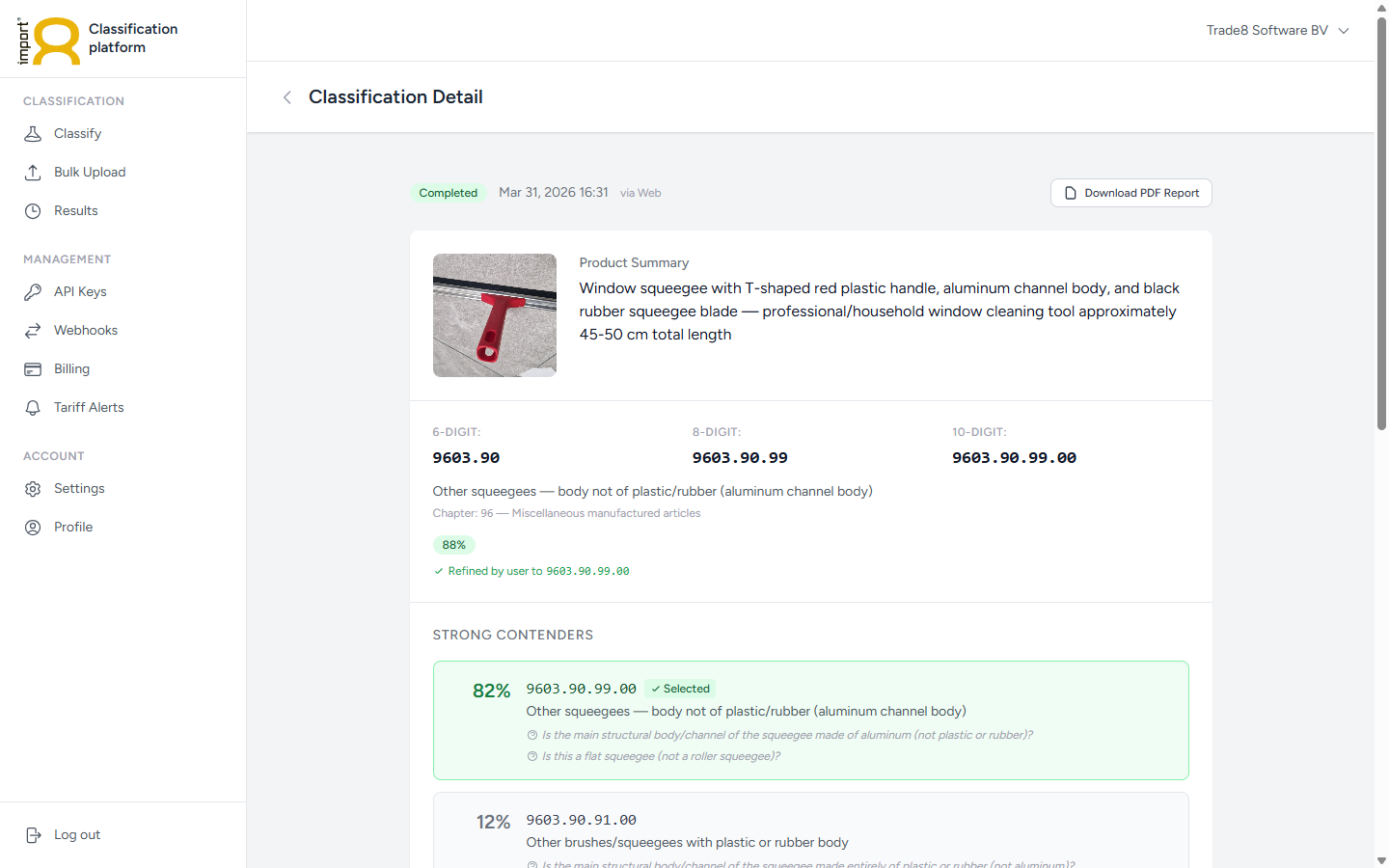
You get one or more codes, each with a confidence and the reason. If two codes are close, you see the reasoning and decide yourself.
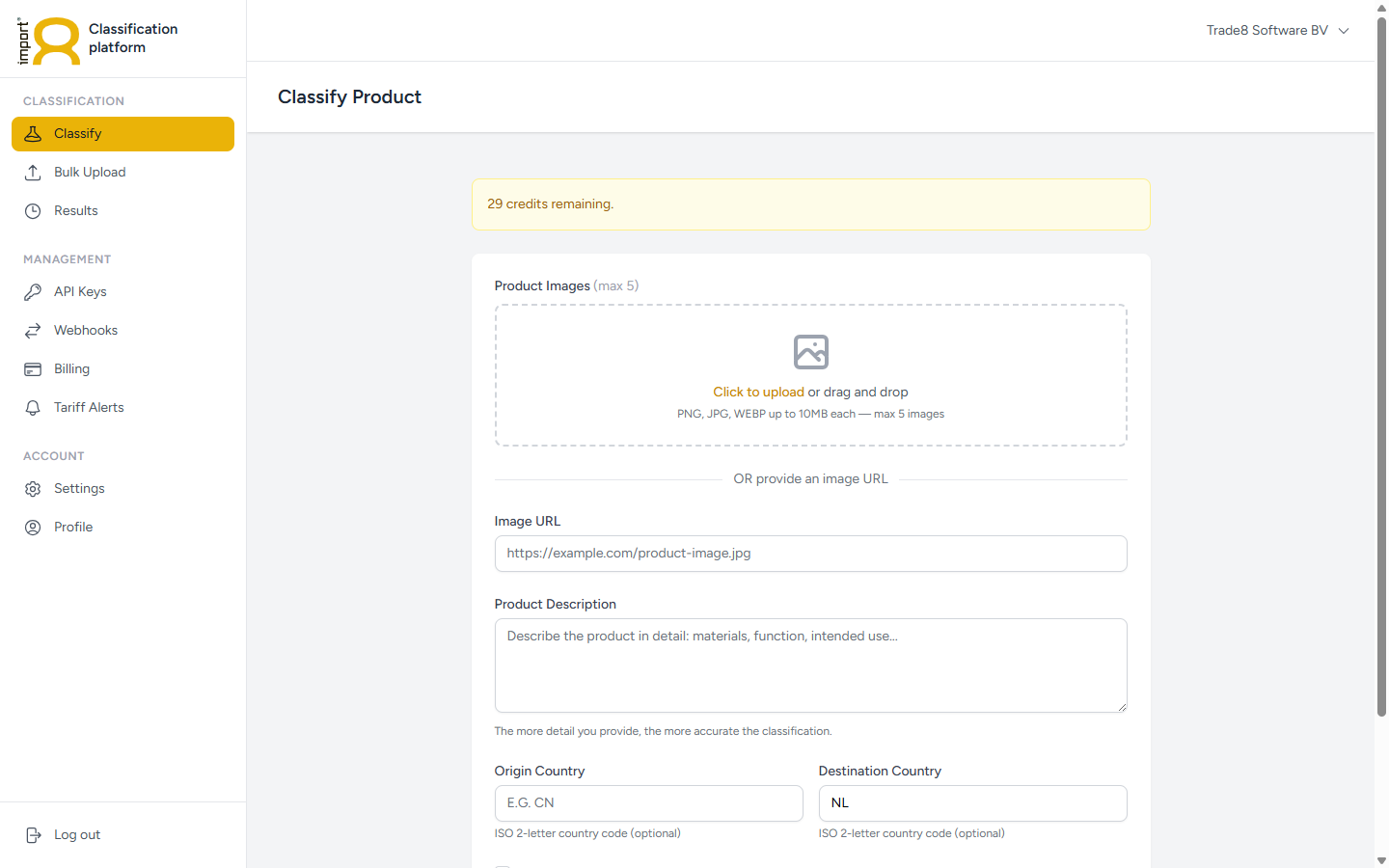
Import8 finds the HS code with the reason, so you can check it.
How an HS code is built
HS codes go from broad to narrow: 2-digit chapters, 4-digit headings and 6-digit subheadings, which are the same everywhere. The EU extends that to 8 digits (CN code) and 10 digits (TARIC code). You put the 10-digit TARIC code on your declaration. It decides your rate, whether anti-dumping applies and whether you fall under a quota. An explanation per level, with examples and the classification rules, is in HS codes explained.
Difficult cases
Not every product fits neatly under one code. Even experienced importers struggle with these.
Products of several materials
A backpack with a nylon outer, leather straps and a metal frame: do you classify it by the nylon, the leather or the metal? That depends on which material gives the product its essential character (GIR 3(b)). For this backpack it is the nylon outer.
Sets
A gift set with a ceramic mug, a bag of coffee beans and a wooden spoon: three chapters in one box. Under GIR 3(b) you classify the set by the part that gives it its essential character. If that is the mug, the whole set falls under ceramics (6912). If no part decides it, GIR 3(c) says: take the code that comes last in numerical order.
Parts and accessories
A replacement screen for a laptop is a part and usually follows the code of the device (chapter 84). A laptop sleeve is an accessory with its own code (chapter 42). The difference matters, because a part often gets the same rate as the device and an accessory does not.
Unfinished products
Under GIR 2(a) you classify an unfinished product as the finished one if it already has its essential features. A bicycle shipped in pieces is still a bicycle (8712). A frame on its own is a bicycle part (8714). That line is often disputed.
Electronics with several functions
A smartwatch tells the time (chapter 91), measures data (chapter 90), processes data (chapter 84) and sends it wirelessly (chapter 85, for example heading 8517). A fitness tracker without a screen can fall under chapter 90 as a measuring instrument. Such devices are hard to classify, and customs in different EU countries does not always agree.
5 tips for the right HS code
Look first at what the product is
The classification looks first at what a product is: the material and the function. The use only counts after that. A "silicone mat" can be a baking mat (plastics), an insulating mat or a yoga mat. So describe what it is and what it is for.
Read the section and chapter notes
The notes at the start of each section and chapter say what falls in and what does not, and they come first. Note 1(a) to chapter 85 excludes electrically heated blankets: they belong in chapter 63, even though they contain electronics. Skipping the notes is the most common mistake. More in HS code mistakes.
Use the General Rules for the Interpretation (GIR)
The six GIR are the legal framework for classification. Rule 1: start with the heading text and the notes. Rule 3: what to do when a product fits several headings. Rule 6: subheadings within a heading work the same way. Every choice rests on these rules. The WCO publishes them in full.
Look at BTIs for similar products
The EU publishes all Binding Tariff Information decisions in the EBTI database. Search for products like yours and see how customs classified them. Another company's BTI is not binding for you, but it shows how customs applies the rules. Especially useful in borderline cases.
When in doubt, request a BTI or ask a broker
If the classification is really unclear and a lot of money is at stake, request a BTI or ask a licensed customs broker. That advice almost always costs less than a wrong code found in an audit. You can also check your codes with the free HS code check of Import8.
Not sure your code is right?
The free HS code check puts your code next to the result of Import8 and shows where they differ.
Questions
Partly. The first six digits are the same in all WCO countries. After that each country or trade bloc adds its own digits. The EU uses 8-digit CN codes and 10-digit TARIC codes, the US uses 10-digit HTS codes. A product with the same 6-digit code therefore has a different full code, and maybe a different rate, in the EU than in the US. Always use the nomenclature of the country you import into.
Then you use the General Rules for the Interpretation. GIR 3(a): the most specific description wins. If two headings are equally specific, GIR 3(b) says you classify by the material or part that gives the product its essential character. If that does not settle it, GIR 3(c) says: take the heading that comes last in numerical order. That is not a penalty and not always the highest rate, it is just the tie-breaker. If you are really unsure, request a BTI.
The WCO revises the Harmonized System every five years. The last major revision (HS 2022) came into force on 1 January 2022, with new codes for drones, smartphones and 3D printers, among others. The next version, HS 2028, comes into force on 1 January 2028. TARIC changes more often: rates, measures and anti-dumping can change at any time through an EU regulation. Review your codes at least once a year.
No. The TARIC code and the rate are the same in all 27 EU countries, because the EU is one customs territory with one external tariff. Whether you import through Rotterdam, Hamburg, Le Havre or Piraeus, you use the same 10-digit code and pay the same rate. What differs per country is the import VAT (21% in the Netherlands, 19% in Germany and so on) and some national excise duties, such as on alcohol and tobacco.
You may classify yourself. You are not required to use a broker, and many importers do it themselves, certainly for simple products. As the importer you remain responsible for the right code, whoever found it. For difficult products, products of several materials or expensive shipments with a large rate difference between two codes, advice pays off. Import8 is in between: faster than searching yourself, with the reason so you can check the result.
A Binding Tariff Information (BTI) is a decision by customs on the code of your product. It is binding in all EU countries for three years. Requesting it is free, but it takes 30 to 120 days and you have to provide a detailed description, photos and sometimes a sample. A BTI pays off when (a) the classification is really unclear, (b) you import the product often and (c) a wrong code costs a lot of money. For a product with a clear code you do not need it.