Why so much comes from China
China is the largest source of goods imported into the EU. In 2025 the EU imported about €560 billion from China, over 22% of all imports from outside the EU (source Eurostat). From electronics and machinery to textiles and consumer goods, Chinese factories supply almost every industry.
The reasons are simple: a lot of production capacity, low prices, factories used to exporting and a wide range of products. For a European business, buying in China often means a much lower price per unit. That only pays off if customs, the rules and the shipping are arranged properly.
This guide goes from supplier to customs, with what you need to know as an EU importer.
EU imports from China (2025)
of all imports from outside the EU
no trade agreement between the EU and China, so the full normal rates apply
The import process step by step
Importing from China is a series of decisions, and each one affects your cost and your timing. In short:
Choose a supplier
Find a factory or trading company. Check that they are real, ask for samples, and agree the price and the minimum order quantity (MOQ).
Find the HS code
Find the right HS or TARIC code before you order. It decides your duty, any anti-dumping duty and the certificates you need.
Calculate the cost
Add up the product, freight, insurance, import duty, anti-dumping (if it applies) and VAT. What counts is the total cost at the border, not the FOB price.
Check the quality
Arrange an inspection before shipping. Check the specs, packaging, labels and markings (CE, REACH and so on) before the goods leave China.
Ship
Choose sea freight (25 to 40 days), air freight (5 to 10 days) or rail (18 to 22 days). Use a forwarder and insure the shipment.
Customs
File the customs declaration with all documents. Pay the import duty and VAT. The goods are then released for free circulation in the EU.
Delivery
After clearance the goods go to your warehouse or straight to your customers. Once cleared in one EU country, they can move freely within the EU.
Important: do steps 2 and 3 before you order. If you know the HS code and the total cost in advance, there are no surprises at the border. With the free duty calculator you can estimate the cost before you order.
Finding a reliable supplier
Your supplier decides the quality, the reliability, the delivery time and how easily problems get solved. These are the options:
Factories (direct)
A lower price per unit, but higher minimum quantities (often 500 units or more). Good for products you keep ordering. You deal with the factory itself, so you have more say over specs and changes.
Trading companies
A higher price per unit (10 to 30% markup), but lower minimum quantities, and they deal with the factory for you. They often speak better English and can buy from several factories. Good for a first import or a mixed range.
Sourcing agents
A sourcing agent represents you in China. They find factories, negotiate prices, arrange inspections and handle the shipping. Useful if you import several product groups or have no experience with Chinese factories yet.
Where to find suppliers
The main platforms are Alibaba (the largest, widest range), Made-in-China (more factories directly) and Global Sources (checked suppliers, good for electronics). For larger purchases, the Canton Fair in Guangzhou (twice a year) is still the most important trade fair to visit.
Checking a supplier
HS codes and classification
Every product that enters the EU needs a TARIC code of 10 digits. It decides your duty, the measures that apply and the rules your product must meet. For goods from China it matters even more, because many product groups from China have extra measures, such as anti-dumping, safeguard duties or surveillance.
You start with the international HS code (6 digits, the same everywhere), then the EU Combined Nomenclature (8 digits) and finally the TARIC code (10 digits) with all EU measures.
A wrong code costs money:
If your rate is too low
Customs can claim the difference on up to 3 years of past imports, with a fine on top. It can also lead to a fraud investigation.
If your rate is too high
You pay too much on every shipment. On €100,000 of imports a year, 3% too much costs you €3,000 a year, and you only get it back if you claim it.
Why the code matters more for China
China has no trade agreement with the EU, so the full normal rates (MFN) apply. On top of that, many product groups from China are under anti-dumping duties, sometimes higher than the product itself costs. These depend on the TARIC code and the country of origin. One wrong digit can be the difference between no anti-dumping and a lot of it. See our guide to anti-dumping.
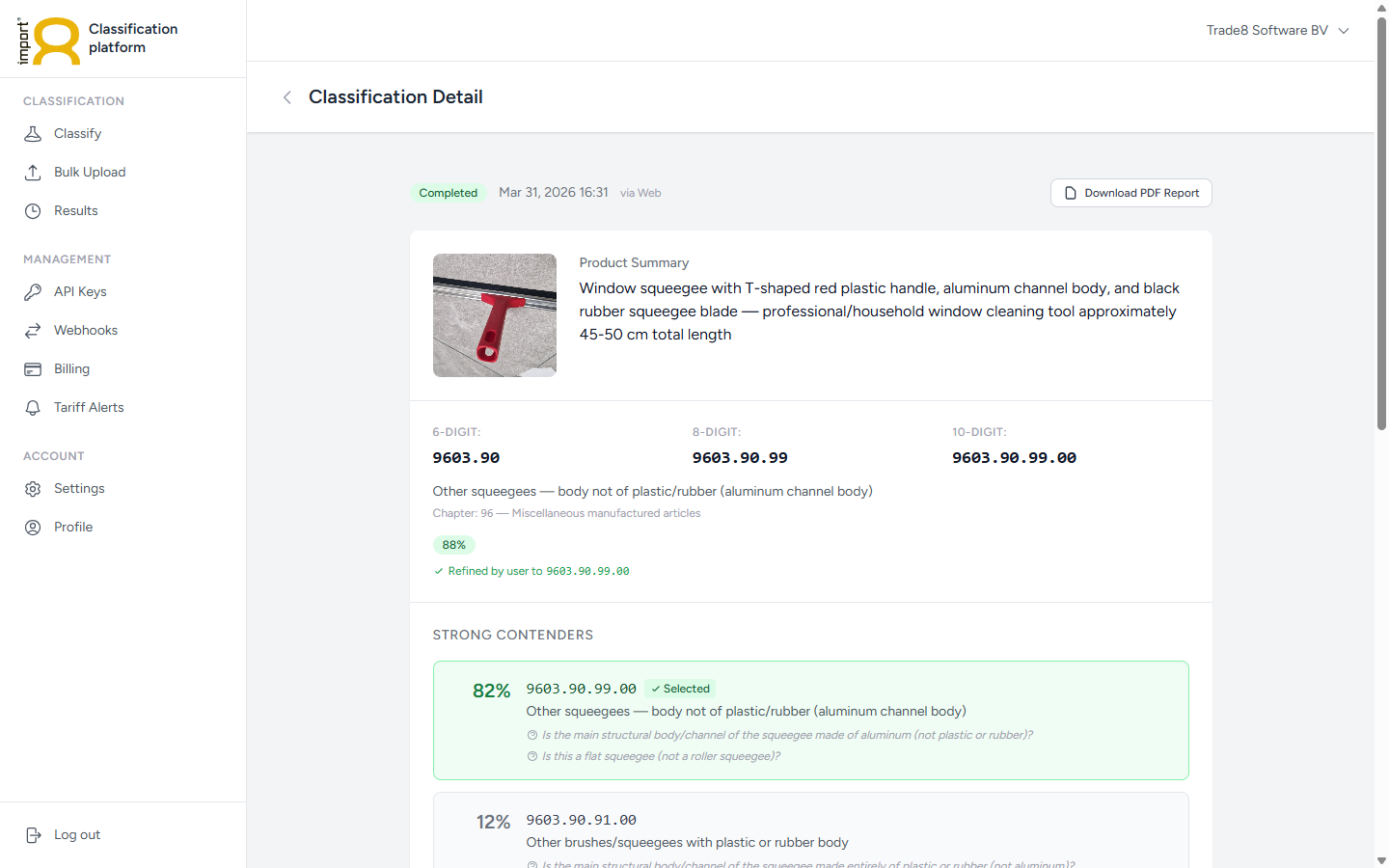
Not sure about your HS code?
Upload a product photo or description and get the TARIC code with the reason. You start with 5 free credits, no credit card needed.
Duty, VAT and anti-dumping
When you import from China into the EU, you can pay three kinds of tax:
Normal import duty (MFN)
The basic rate, decided by your TARIC code. Goods from China pay the normal rate (usually 0 to 17% for manufactured goods). It is calculated on the customs value (CIF: goods plus insurance and freight to the EU border). More in our guide on how EU import duty is calculated.
Example: €50,000 CIF × 6.5% = €3,250
Anti-dumping and countervailing duties
Extra duties on products the EU has found are sold below market price (dumping) or subsidised. They come on top of the normal duty and can be high. Examples from China:
Always check the EU trade defence overview before you import. Anti-dumping measures change regularly and can come or go after new EU investigations.
Import VAT
VAT is charged on the customs value plus all duties. The rate depends on the EU country of import (21% in the Netherlands, 19% in Germany, 20% in France and so on). You can usually deduct import VAT in your normal VAT return, so it costs you cash flow, not money.
Example: (€50,000 + €3,250) × 21% = €11,182.50
Example: total cost of a €50,000 shipment from China
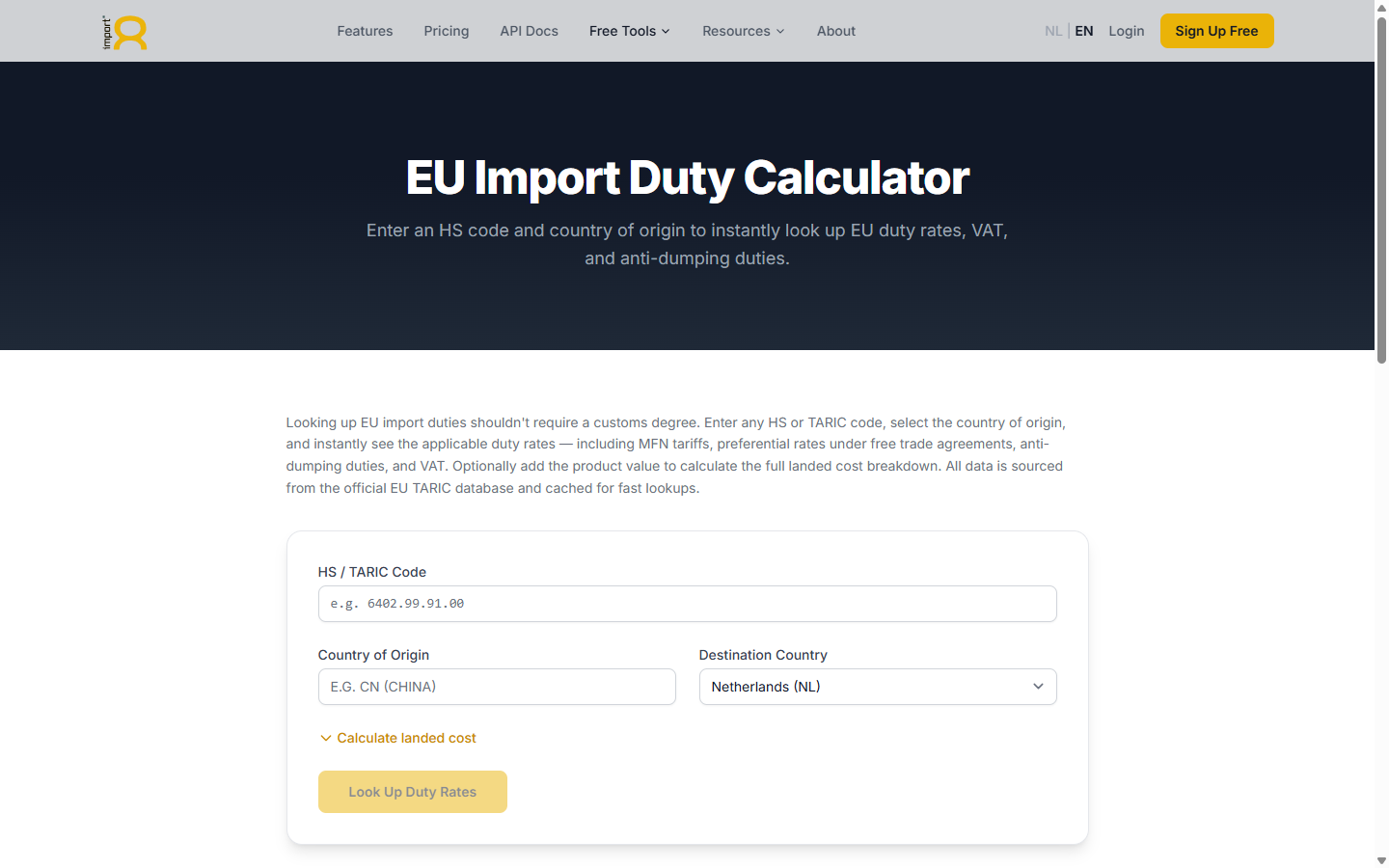
Estimate your own cost with the free duty calculator.
Documents
Missing or wrong documents are one of the most common reasons a shipment is held. For every shipment from China to the EU you need these:
Commercial invoice
Made by the seller. It must show the buyer and seller, the product descriptions, quantities, unit prices, total value, currency, Incoterms and the country of origin. Customs bases the value on it.
Packing list
A list of everything in the shipment: what is in each box or pallet, with weights and sizes. Customs uses it to check the invoice and to choose goods for inspection.
Bill of lading (B/L) or air waybill (AWB)
The transport document: a B/L for sea freight, an AWB for air freight. It proves the shipment, and for sea freight it is also a document of title (whoever holds the original B/L can collect the goods).
Certificate of origin (if needed)
Not always needed for goods from China, because there is no trade agreement. Customs can ask for it to check anti-dumping or the origin.
CE declaration of conformity
Needed for products under EU CE rules (electronics, toys, machinery, medical devices, PPE and so on). As the importer this is your responsibility, not the Chinese factory's.
Customs declaration
The formal declaration to customs, usually filed electronically by your broker. It needs the TARIC code, the customs value, the origin and all supporting documents.
Tip: ask your supplier to put the HS code on the commercial invoice, but always check it yourself. Chinese export codes often differ from EU import codes, and copying the supplier's code is a common cause of mistakes.
Who is the importer of your shipment, you or your forwarder? →
Which documents does your product need?
Enter your HS code and see which EU rules (CBAM, GPSR, REACH, anti-dumping) apply to your product and which documents go with them. Free, no account needed.
Does your shipment also hold up at customs?
Do you already have the invoice and packing list from your supplier? Every shipment also needs documents that are right. Import8 checks your invoice and packing list before customs sees them. You see what is missing, with the legal source, plus a message you can send straight to your supplier.
Create a free account: 5 credits, no credit card. Import8 helps you prepare and is not customs advice.
EU rules and product safety
The EU has strict rules for product safety. As the importer you are legally responsible for making sure your products meet them, not the Chinese factory. If a product that does not meet the rules is found on the EU market, customs and the market surveillance authorities come to you.
CE marking
Required for more than 25 product groups, including electronics, toys, machinery, medical devices, construction products and PPE. CE marking means the product meets the EU rules for safety, health and environment. You need a technical file and a declaration of conformity, and for some groups testing by an outside body.
REACH
Restricts or bans certain chemicals in products sold in the EU. It applies to almost everything: textiles, electronics, toys, furniture, plastics. Your supplier should give a REACH declaration, but you have to check it. Common problems: lead in paint, phthalates in plastics, PFAS in textiles.
RoHS
Restricts hazardous substances (lead, mercury, cadmium and others) in electrical and electronic equipment. If you import electronics from China, it must meet RoHS.
GPSR (General Product Safety Regulation)
The EU product safety regulation (in force since December 2024) requires, for many consumer products, an economic operator in the EU. Whether that applies depends on your product and whether a responsible party is already in the EU. If it applies to you, you must be reachable, keep the technical documents and cooperate with the market surveillance authorities. Check it per product.
EUDR (deforestation regulation)
If you import wood, palm oil, soy, rubber, cocoa, coffee or cattle products, you must show from December 2025 that your supply chain is free of deforestation. This applies whatever the country of origin.
Note: products that do not meet the rules can be seized at the border or recalled, and you can be fined. Count the cost of testing and certificates as part of your import cost.
Shipping

How you ship affects your cost, your delivery time and your risk. The three main options from China to the EU:
| Sea freight | Air freight | Rail (China-EU) | |
|---|---|---|---|
| Transit time | 25-40 days | 5-10 days | 18-22 days |
| Cost (approx.) | €1,500-4,000 per container | €3-8 per kg | Between sea and air |
| Best for | Large, heavy, not urgent | Small, valuable, urgent | Medium size, time matters |
| Arrives in the EU at | Rotterdam, Hamburg, Piraeus | Schiphol, Frankfurt, Liège | Duisburg, Hamburg, Tilburg |
Incoterms: who pays for what?
Incoterms decide which costs and risks are yours and which are the seller's. The three most used for China-EU trade:
7 mistakes that cost money
These mistakes happen often, and each one costs real money.
1. Using the supplier's HS code without checking it
Chinese export codes and EU import codes are different systems. A code that is right for Chinese customs can be wrong for EU customs. Always check it in TARIC or have the code found for you. It is one of the common HS code mistakes.
2. Forgetting anti-dumping
You expected 6% duty, but there is an anti-dumping duty of tens of percent on your product from China. Then a profitable import becomes a loss. Check it before you order.
3. A lower value on the invoice
Some suppliers offer to put a lower value on the invoice so you pay less duty. That is customs fraud. EU customs uses data analysis to spot values that are too low, and the penalties include the duties back to the start plus fines.
4. Skipping the tests
A CE mark on the product does not mean it meets the rules. Some factories add the mark without testing. You need the documents: test reports, declaration of conformity, technical file. If the market surveillance authority asks, "I trusted my supplier" is not an answer.
5. No inspection before shipping
The sample was fine, the bulk order is not. Without an inspection before shipping you now have a container of poor goods in Rotterdam and few options. Count on a few hundred euros per inspection by an outside party. It is the cheapest insurance in the whole chain.
6. Paying everything up front
The usual terms are 30/70: 30% deposit, 70% after the inspection and before shipping. If you pay everything up front, you lose your leverage. If there is a quality problem, getting money back from China is very hard.
7. Not calculating the total cost before ordering
The FOB price is not your cost. Add freight, insurance, duties (check anti-dumping), VAT, broker fees, inland transport and storage. Otherwise you find out at the border that your margin is gone.
Questions
Usually not. You need a registered business with an EORI number, which you get free from your national customs. Some product groups need extra permits: food and agricultural products (health certificates), chemicals (REACH registration), medicines, weapons and certain dual-use goods.
With the right documents, clearance in the EU usually takes 1 to 3 working days. If your shipment is chosen for a physical inspection, add 2 to 5 days. Common delays: missing or wrong documents, questions about the HS code, CE or REACH checks and anti-dumping checks. Having all documents complete and correct before the goods arrive is the best way to avoid delays.
Yes, but importing commercially requires a registered business and an EORI number. Since 1 July 2026 there is no longer a duty exemption for e-commerce shipments to consumers under €150: goods sold remotely to consumers in the EU, up to €150, pay a flat €3 per type of item (tariff subheading) from 1 July 2026 until 1 July 2028. Since 1 November 2026 a handling fee of €2 per type of item comes on top. Five T-shirts in one parcel cost €5 in total, a T-shirt and a watch €10. If you always order one product per parcel, you pay €5 per shipment, even if the product costs only a few euros. Import VAT applies too. For commercial quantities you need a business and should work with a customs broker unless you know the process.
These are Incoterms that decide who pays for what. FOB (Free On Board): the seller delivers to the ship, you pay everything from there. CIF (Cost, Insurance, Freight): the seller pays freight and insurance to the port of destination, you pay from the port on. DDP (Delivered Duty Paid): the seller arranges everything, including customs and duties in the EU. DDP sounds easy, but you have no say over the classification, and if the seller uses a wrong HS code you can still be liable. Most experienced importers choose FOB.
Look up your TARIC code in the EU TARIC database with China as the country of origin. Anti-dumping or countervailing duties show up as extra measures. The duty calculator also includes anti-dumping. New measures are published in the Official Journal of the EU and apply from the date stated there.
Contact your customs broker right away. Common reasons: missing documents (send them), a question about the HS code (have your reasoning ready), a compliance check (send CE and test certificates) or a physical inspection (wait). While the goods are held you pay storage at the port (count on storage costs per day). Act quickly: with the right documents most problems are solved within days. You can also have the documents of the shipment checked to see what is missing or wrong.