What is import duty?
Import duty (also customs duty or tariff) is a tax on goods that enter a country. In the EU the duty is set by the EU and is the same in all 27 countries. You pay the same rate whether the shipment arrives in Rotterdam, Hamburg or Piraeus.
The revenue goes to the EU budget. The countries keep 25% as a collection fee. Import duty is not only about revenue: it protects European manufacturers against cheap competition and is part of trade agreements and trade policy.
For you as an importer it is a normal cost. A wrong code or a missed exemption can mean you pay thousands of euros too much, or get a fine for paying too little.
usual EU rates on industrial products
codes in TARIC a product can be classified in
basis for the customs value: goods, insurance and freight
How is import duty calculated?
Import duty depends on three things. If one is wrong, your calculation is wrong.
The HS or TARIC code
Every product has a 10-digit TARIC code with its own rate. Wireless headphones (8518.30.00) pay 0%. Plastic toys (9503.00.95) pay 4.7%. So the code matters a lot.
The customs value
That is the CIF value: the price of the goods plus insurance and freight to the EU border. So transport and insurance count too.
The country of origin
The EU has trade agreements and preferential rates with many countries. The same product can enter at 0% from South Korea and pay the full rate from China. The origin decides which rate applies.
The formula
Example: you import 500 bamboo cutting boards from China. Goods: €2,000. Freight: €400. Insurance: €50.
Customs value (CIF) = €2,000 + €400 + €50 = €2,450
HS code 4419.19.00 (wooden kitchenware): rate 0%
Import duty = €2,450 × 0% = €0
In the Netherlands you do pay 21% VAT on the customs value. Only the duty is zero for this product.
The customs value
The customs value is more than what you pay for the goods. The EU uses the transaction value (WTO Valuation Agreement), and these costs count:
The HS code decides the rate
The HS code decides most of how much duty you pay. Every product that enters the EU gets a 10-digit TARIC code, and every code has its own rate.
Two products that look alike can have a very different rate:
| Product | HS code | Rate |
|---|---|---|
| Laptop | 8471.30 | 0% |
| Bluetooth speaker | 8518.22 | 0% |
| Cotton T-shirt | 6109.10 | 12% |
| Ceramic tableware | 6912.00 | 12% |
| Bicycle | 8712.00 | 14% |
| Leather shoes | 6403.99 | 8% |
| LED light fitting | 9405.42 | 4.7% |
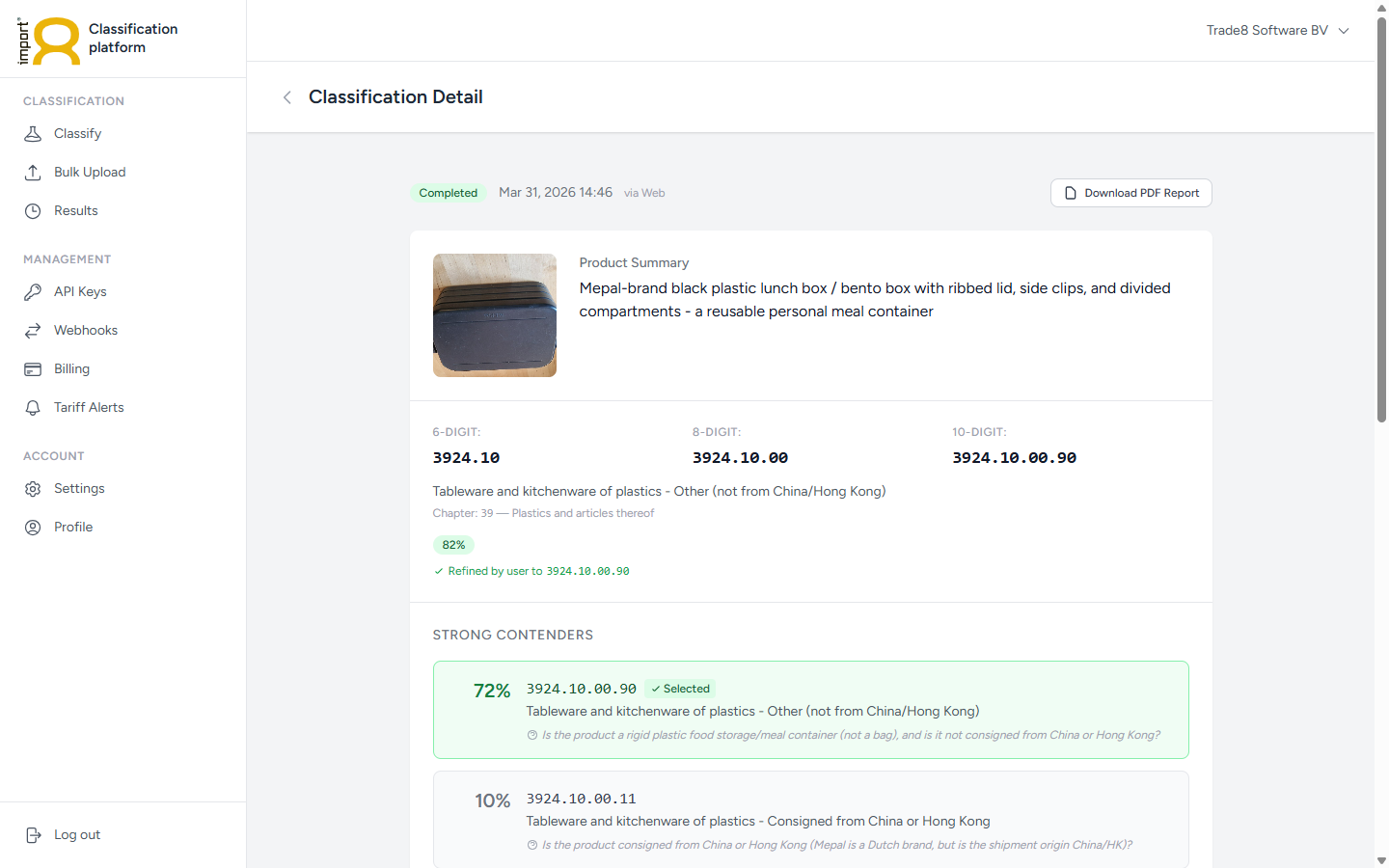
Not sure which HS code fits your product? Have it found for you.
Types of import duty
There are a few types of import duty. Which one applies depends on the product and the country of origin.
Percentage of the value (ad valorem)
A percentage of the customs value, for example 12% on cotton clothing. This is the most common type.
Fixed amount (specific duty)
A fixed amount per unit, such as weight, volume or number. For example €17.60 per 100 kg on certain rice. Mostly used for agricultural products.
Compound duty
A percentage plus a fixed amount, for example 8% + €2.50 per kg. Used when both value and quantity matter, such as for processed food.
Anti-dumping and countervailing duties
Extra duties on products sold below market price (dumping) or subsidised by a foreign government. They can be high: e-bikes from China, for example, carry anti-dumping duties from 9.9% to 70.1%, with countervailing duties on top. See our guide to anti-dumping.
Tariff quotas
Up to a certain quantity a lower rate applies. Once that quantity is reached, the normal, higher rate applies. Mostly used in agriculture. Butter from New Zealand, for example, enters at a lower rate until the quota is used up.
CBAM: if you import more than 50 tonnes of steel, aluminium, cement or fertilisers a year, you also pay for the CO₂ emissions of those goods since 2026.
Learn about CBAMImport VAT
Besides import duty you pay import VAT at the border, on the customs value plus the duty. That is often the larger amount.
What you pay at the border in total
Import VAT in the EU
Preferential rates and trade agreements
The EU has trade agreements with many countries. If your goods come from such a country and you can prove it with a proof of origin, you may pay a lower rate or nothing.
EU-South Korea agreement
Almost all industrial goods enter at 0%.
EU-Japan agreement
Duties on most goods have been removed, including electronics and (step by step) vehicles.
EU-Vietnam agreement
Duties on 99% of tariff lines disappear over 7 to 10 years. More and more relevant as production moves from China to Vietnam.
Generalised Scheme of Preferences (GSP)
Lower rates for developing countries, including many countries in Asia and Africa. You need a REX statement.
China: no agreement
China has no trade agreement with the EU. Goods from China pay the full normal rate (MFN), the rate you see in TARIC. What that means in practice is in importing from China.
Mistakes that cost money
The wrong HS code
The most expensive mistake. With a wrong code you may pay 12% instead of 0%, or get a claim and a fine in an audit. See also HS code mistakes.
Declaring the FOB value instead of CIF
If you declare only the price of the goods, without freight and insurance, your customs value is too low. Customs can correct it and charge interest on the difference. Declaring too low on purpose is fraud.
Missing a preferential rate
Many importers pay the full rate while 0% was possible under a trade agreement. If your supplier is in Vietnam, South Korea or another country with an agreement, check whether there is a preferential rate and ask for the proof of origin.
Forgetting anti-dumping
Anti-dumping comes on top of the normal rate and can be more than 50%. It applies to certain products from certain countries and changes regularly. If you import steel, aluminium, ceramics or e-bikes from China, always check the measures that apply now.
Not counting the duty
Import duty and VAT make your product a lot more expensive at the border. Count them before you place a purchase order, or your margin is gone.
Calculating the duty yourself

This is how you work out what you pay at the EU border.
Step 1: find the code of your product
Find the right HS or TARIC code. Everything depends on it. Start with our guide on how HS codes work, search the TARIC database yourself or have the code found for you. Check your codes with the free HS code check.
Step 2: establish the country of origin
Not the country you buy from, but the country where the goods were made or got their main processing. Whether a preferential rate applies depends on it.
Step 3: look up the rate
Look up your TARIC code with the country of origin in TARIC. You see the normal rate (MFN) and any preferential rates, anti-dumping and other measures.
Step 4: work out the customs value
Goods + freight + insurance = CIF value. Convert to euros if needed.
Step 5: apply the rate
Import duty = customs value × rate. Then add the import VAT, on customs value plus duty. That is what you pay at the border.
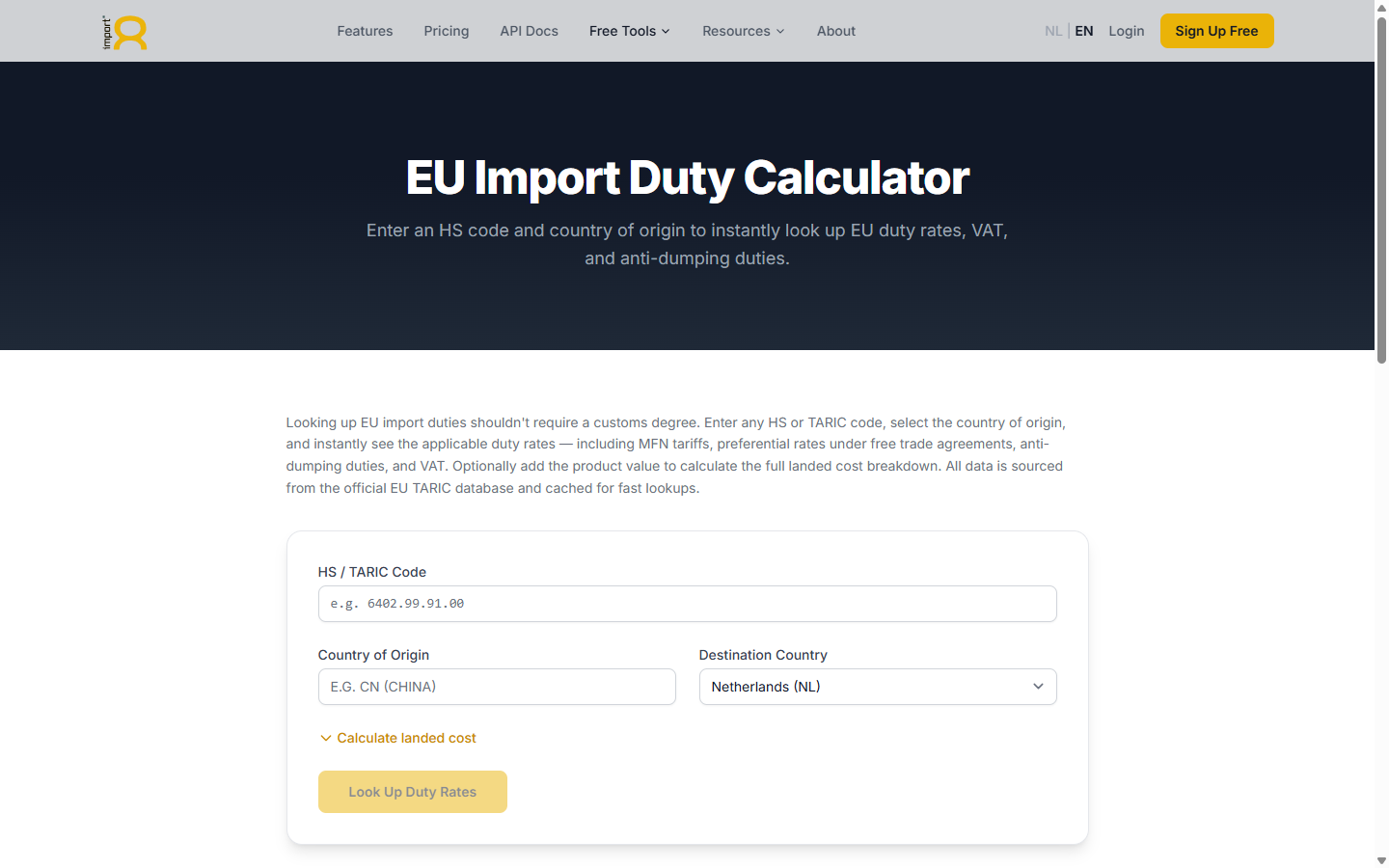
Rather not calculate yourself?
The free duty calculator does steps 3 to 5 for you.
Questions
Not always. Some products have a 0% rate, such as most electronics under the ITA agreement. Goods from a country with a trade agreement can enter without duty with the right proof of origin. The exemption for e-commerce shipments to consumers under €150 no longer exists since 1 July 2026: goods sold remotely to consumers in the EU, up to €150, pay a flat €3 per type of item (tariff subheading) from 1 July 2026 until 1 July 2028. Since 1 November 2026 a handling fee of €2 per type of item comes on top. Five T-shirts in one parcel cost €5 in total, a T-shirt and a watch €10. If you always order one product per parcel, you pay €5 per shipment, even if the product costs only a few euros.
Import duty is an EU charge based on the code and the origin. Import VAT is a national tax (21% in the Netherlands) on the customs value plus the duty. If you are VAT-registered you can deduct the VAT, but not the duty.
Sometimes. If you paid too much because of a wrong code, you can ask for a refund within 3 years. Re-exported goods, faulty goods or goods that do not match the order can also qualify. You apply with your national customs (in the Netherlands, the Douane).
First find the right HS or TARIC code. Look it up in TARIC (ec.europa.eu) with the country of origin. You see the normal rate, preferential rates and other measures. Or use the free duty calculator.
If customs finds a wrong code, the difference can be claimed up to 3 years back. A fine can be added. If it was deliberate, it is customs fraud. Getting the code right the first time is always cheaper than correcting it later.
Since 1 July 2026 the duty exemption for e-commerce shipments to consumers under €150 is gone. Goods sold remotely to consumers in the EU, up to €150, pay a flat €3 per type of item (tariff subheading) from 1 July 2026 until 1 July 2028. Since 1 November 2026 a handling fee of €2 per type of item comes on top. Five T-shirts in one parcel cost €5 in total, a T-shirt and a watch €10. If you always order one product per parcel, you pay €5 per shipment, even if the product costs only a few euros. Import VAT has applied from the first euro since July 2021. Trade samples of negligible value can be exempt. For goods that enter temporarily, for example for a fair or a test, you can use temporary admission and then pay no duty.